 Call: (828) 390-8226


- Morganton Based
Serving Morganton, Valdese, Marion, Lake James, Lake Rhodhiss and the surrounding areas.
- Free Estimates
Three generations of masonry craftsmanship. Call or text (828) 390-8226.
 Morganton Based
 Free Estimates
Retaining Walls
We build retaining walls in segmental block, natural stone, concrete block and wood for yards in Morganton and around Burke County, and we replace the old ones that have started to lean. A retaining wall holds back a slope so the ground behind it can be level: a bank behind a house, a yard cut flat for a patio, the edge of a lake lot. The wall you see is the smaller half of the job. The base under it and the drainage behind it decide whether it is still standing straight after years of wet winters.
Retaining Walls in Morganton, NC
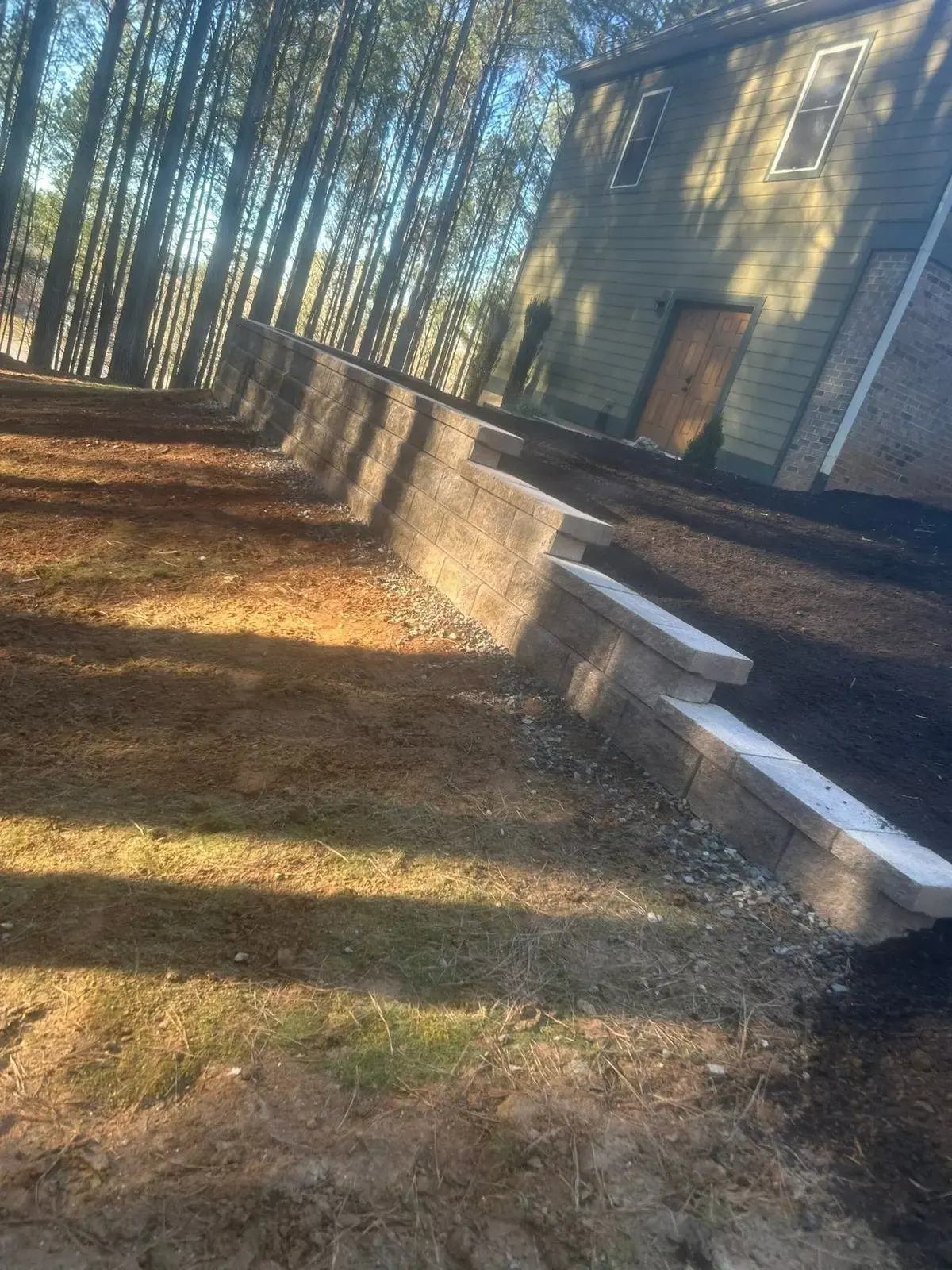
A retaining wall is pushed on all the time. Soil leans on it with its own weight, and soil full of water leans much harder, because water adds weight and pressure that dry soil doesn't have. Most walls that fail give the same signs: a lean out at the top, a bulge in the middle, blocks or stones pushed out of line, or soil washing out at the bottom. Behind almost every one is one of these:
- No drainage. Water builds up behind the wall with nowhere to go and pushes it over.
- No base. A first course set on bare dirt sinks unevenly, and the wall above it follows.
- Too tall for how it was built. A wall that holds back a lot of soil needs reinforcement tying it into the ground behind it.
- Rot. Railroad ties and landscape timbers break down where they stay wet, and the wall goes soft from the inside.
Here the water part matters most. NOAA's 1991-2020 normals for Morganton give 51.53 inches of rain and melted snow a year, and every inch of it that soaks into a bank has to come out somewhere. A wall built to let it out doesn't have that water pushing on its back.
When a Retaining Wall Needs an Engineer in North Carolina
Some walls need a design on paper before they are built. The North Carolina Residential Code (its section R404.4) says: "Retaining walls that meet the following shall be designed by a registered design professional." The walls it lists include "Any retaining walls on a residential site that cross over adjacent property lines regardless of vertical height," and "Individual retaining walls supporting unbalanced backfill exceeding 5 feet (1524 mm) in height within a horizontal distance of 15 feet (4572 mm) or less."
In plain words: a wall on a house lot that crosses onto a neighbor's property, at any height, or one holding back more than 5 feet of soil within 15 feet, is designed by an engineer or an architect. That design comes first, before anyone digs. Whether a wall needs a permit is the county's call, so check with the county before the work starts. On a tall wall, ask about both.
How We Build a Retaining Wall, Step by Step
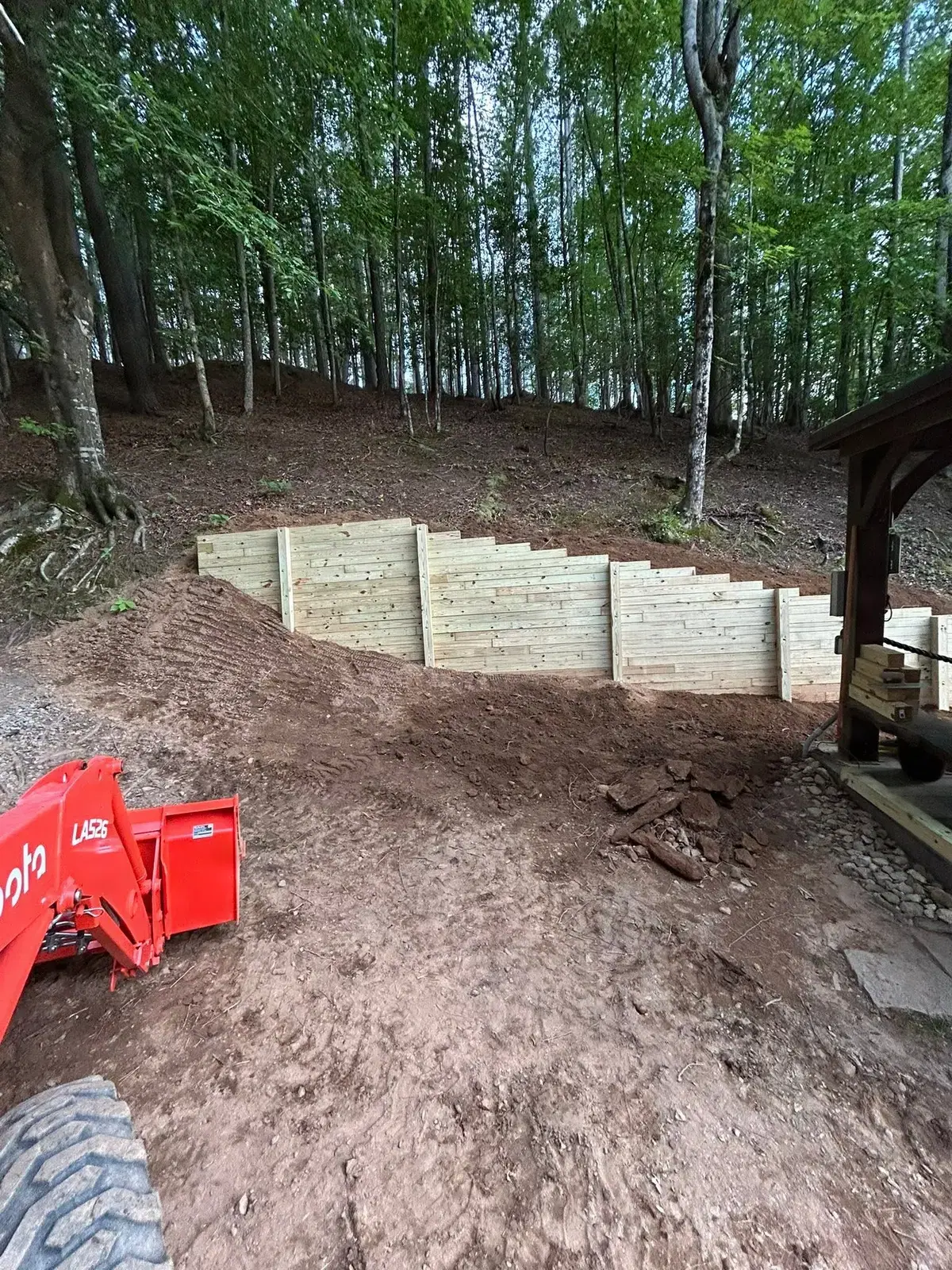
Each step below answers one of the ways walls fail:
- Mark and dig. Buried lines are marked through NC 811, then a trench is dug along the wall's line, wide enough for the base and the drainage stone behind it.
- Compact a gravel base. Crushed gravel goes in the trench and is compacted in layers into a firm, level pad. It spreads the wall's weight and lets water drain away under it.
- Set the first course level and buried. The bottom course is the one everything else follows, so it is leveled block by block and set partly below grade, which keeps the toe of the wall from kicking out.
- Step each course back. Each course sits a little behind the one under it, so the wall leans into the hill it holds. Segmental block has this setback built into its lip or pins.
- Drainage behind the wall. Clean drainage stone fills the space behind the blocks, with a perforated pipe along the bottom that carries water out to daylight or another place it can go. It is the same idea as a French drain, laid behind the wall.
- Geogrid on taller walls. Sheets of geogrid laid between courses run back into the compacted soil, tying the wall and the ground behind it into one heavy block.
- Backfill and cap. Soil behind the drainage stone is compacted in layers, not dumped, and caps finish the top course and keep water out of the cores.
Block, Stone or Wood: Choosing a Retaining Wall
The material changes how a wall is built more than how it looks:
- Segmental block. Dry-stacked concrete units made for retaining walls, with a lip or pins that set the setback. No mortar, so water drains through the joints, and they take geogrid well on taller walls.
- Natural stone. Stacked dry with the stones tipped back into the bank, or laid in mortar on a concrete footer. A dry-laid stone wall drains through its own joints.
- Concrete block. Standard block laid in mortar on a poured footer, with rebar run up through the cores and the cores filled with concrete. It needs weep holes or a drain behind it, because mortared joints hold water back.
- Wood. Pressure-treated timbers rated for ground contact, tied back into the bank with deadmen, timbers that run back into the soil behind the wall. Wood has the shortest life of the four, so the drainage behind it matters even more.
Old railroad tie walls fail in a familiar way: the ties rot where the soil stays wet, and the wall bows out. We replaced one at Lake Rhodhiss in January 2026, pulling out the old tie wall and building a new retaining wall in its place, then topsoiling the whole yard so it was ready for grass. The yard work around a new wall is on our landscaping page.
What Decides the Cost of a Retaining Wall
A retaining wall is priced on the site as much as the wall. What decides it:
- Length and height. Height matters most, because a taller wall needs a deeper base, more drainage and often geogrid.
- Block, stone or wood. Each material has its own cost and its own method.
- Drainage. Drainage stone, pipe and where the water is carried to.
- Digging and soil. How much of the bank comes out, and whether the soil is hauled away or used to level the yard.
- An old wall to remove. Pulling out rotten ties or a fallen wall first.
- Access and caps. Whether a machine can reach the wall, and the cap stones on top.
Many walls go in to make room for something flat, and the level ground behind a wall is a natural place for a concrete patio. We build retaining walls from Morganton east to Valdese and Hickory. Call or text (828) 390-8226 or send photos through the contact form for a free estimate.
Got a Bank That Needs Holding Back?
Call (828) 390-8226 for a free estimate.
Photos From Our Jobs
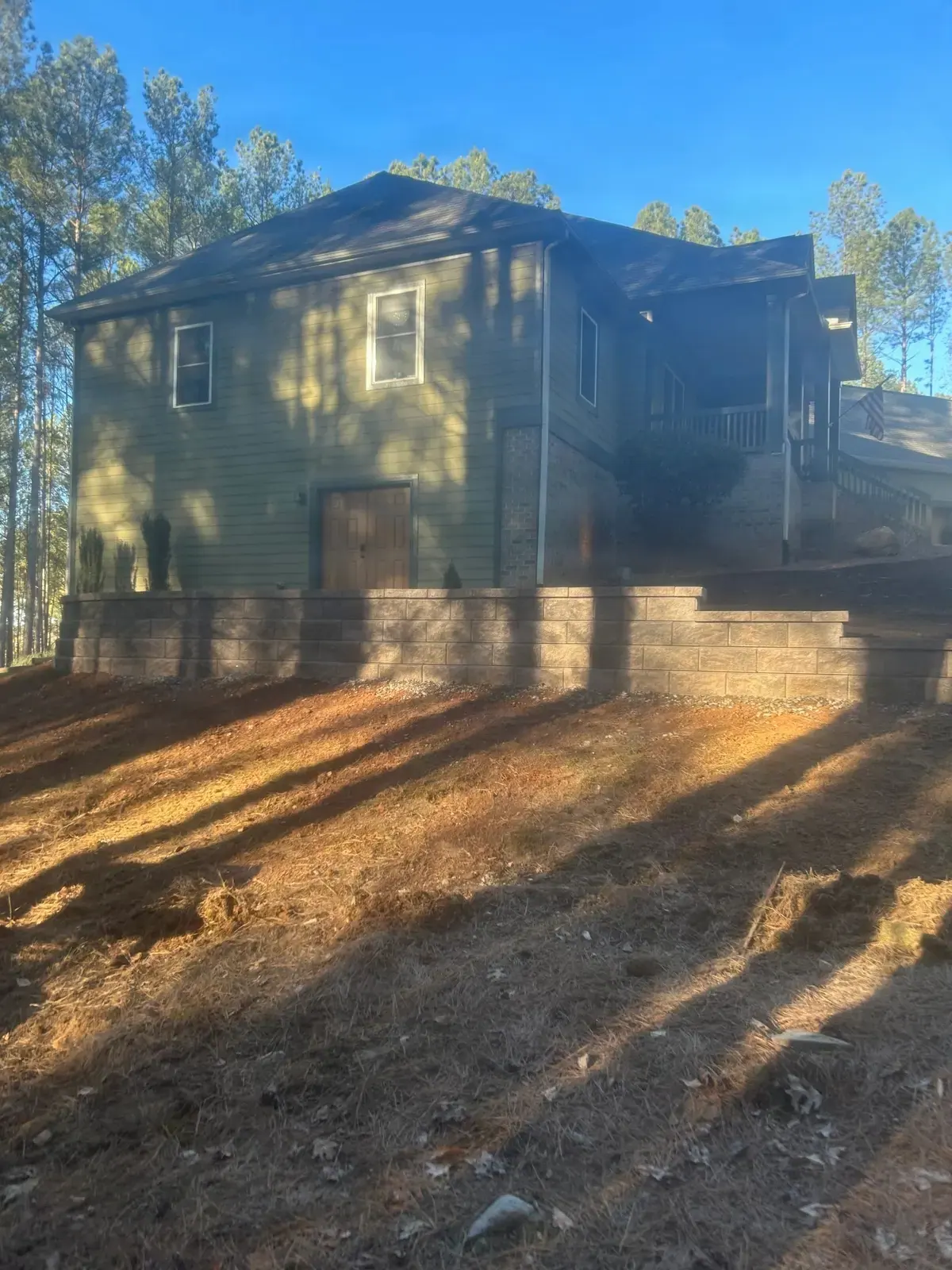
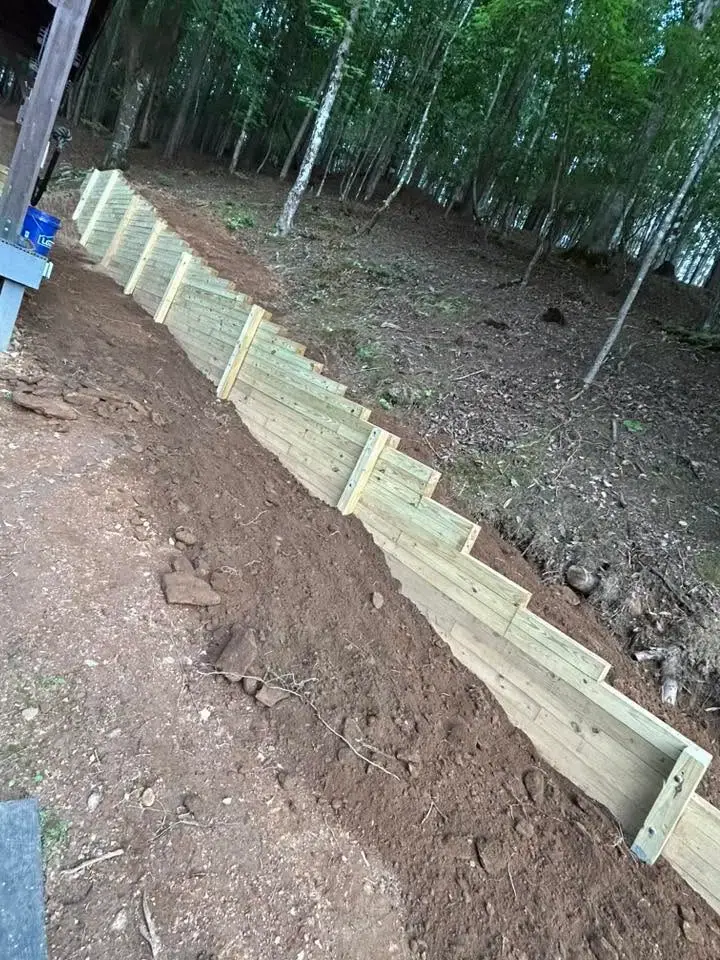
Every photo here is from one of our own jobs. Tap one to see it bigger.



Questions We Hear a Lot

-
It depends on the wall's length and especially its height, the material (segmental block, stone, concrete block or wood), the drainage behind it, how much soil is dug out or hauled off, access and the caps. Send us photos of the slope or call (828) 390-8226 for a free estimate.
-
It depends on why it leans. A few loose caps or a short section knocked out of line can often be reset. A wall leaning from water pressure behind it, or one built of rotting ties, usually has to come down and be rebuilt with a proper base and drainage, and the cost follows from which one it is.
-
We don't put a number of years on wood. How long it lasts depends on whether the timbers are treated for ground contact, how wet the soil behind it stays, whether it has drainage, and how tall it is. When the timbers go soft or the wall bows, it is time to replace it, often with block or stone.
-
There is no single number: it depends on the wall's height, how it is anchored back into the bank with deadmen, the soil, and above all water, because wet soil pushes much harder than dry soil. A taller wall that holds back more than 5 feet of soil within 15 feet is designed by an engineer or architect under the North Carolina Residential Code.
-
Under the North Carolina Residential Code, an engineer or architect designs any wall on a house lot that crosses a property line, whatever its height, and walls holding back more than 5 feet of soil within 15 feet. Whether your wall needs a permit is the county's call, so check with the county before the work starts.
-
Yes. We offer free estimates. Call (828) 390-8226, send us a message on Facebook or use the contact form.
-
We serve Morganton, NC and the surrounding areas. Recent jobs include Lake James, Lake Rhodhiss, Valdese and Marion. Call (828) 390-8226 to check your location.
-
- Service Area Morganton, NC & surrounding areas:
Valdese, Marion, Lake James & Lake Rhodhiss - Free Estimates Call, text or message usMorganton, NC & nearby
- Find Us Online


