 Call: (828) 390-8226


- Morganton Based
Serving Morganton, Valdese, Marion, Lake James, Lake Rhodhiss and the surrounding areas.
- Free Estimates
Three generations of masonry craftsmanship. Call or text (828) 390-8226.
 Morganton Based
 Free Estimates
French Drains, Grading & Excavation
We put in French drains, grade yards and do the small excavation that comes before masonry: trenches for footers, a bank dug back for a wall, a yard cut level for a patio. Next to stone, brick, block and concrete, light construction and excavation are part of the work we take on. Drainage trouble usually shows up one of three ways: water running toward the house, standing in the yard for days after a rain, or washing a bank out a little more every storm. NOAA's 1991-2020 normals for Morganton put the rain and melted snow at 51.53 inches a year. Every bit of it has to go somewhere, and a drain or a graded slope decides where.
French Drains in Morganton, NC: How They Work
A French drain is a gravel-filled trench with a pipe in the bottom. Water in the soil finds it easier to move into loose gravel than through packed dirt, so it drops into the trench, enters the pipe and runs downhill to an outlet. Built in order:
- Find the outlet first. A drain is only as good as where it ends. The water needs a place to go: daylight on lower ground, a ditch, or a dry well, a gravel-filled pit that lets water soak back into the ground.
- Dig a sloped trench. The trench falls steadily the whole way to the outlet. Common guidance is at least 1 inch of fall for every 8 feet of pipe, and more is better.
- Line it with filter fabric. The fabric lets water through and keeps silt out, so the gravel doesn't clog with mud over time.
- Gravel, pipe, gravel. A bed of washed gravel, then perforated pipe with the holes facing down, so water rises into it from below, then more washed gravel over the pipe.
- Fold the fabric over. The fabric wraps over the top of the gravel, closing it in so soil can't wash down into it.
- Finish the top. Soil and grass over it where it runs through a lawn, or stone left showing where it catches water off the surface.
Where the drain runs matters as much as how it is built. Along the foot of a slope it catches water coming down the hill before it reaches the house. Next to a foundation it carries water away from the wall. Across a soggy part of the yard it drains the water out of the ground.
Yard Grading and Leveling
Grading is shaping the soil so water runs where you want it. The common guidance for the ground around a house is a fall of about 6 inches in the first 10 feet out from the foundation. A yard that has settled flat or tips back toward the house sends roof water and rain straight to the foundation, and water standing against a wall works into the crawl space and the mortar joints. Over the years it can crack and push a block foundation wall. A wall that is already cracked or bowed is on our foundation repair page.
The grading work itself, step by step:
- Set the grades. Stakes and a level line mark how high the soil finishes at the house and how far it falls toward the low point.
- Cut and fill. Soil comes off the high spots and goes into the low ones, and new fill comes in where there isn't enough.
- Compact the fill. Fill goes in and is compacted in layers, so it doesn't settle back into a dip and hold water against the house again.
- Swales. A wide, shallow channel shaped into the yard leads water around the house or between two slopes, toward the outlet, without a pipe.
- Topsoil. A layer of topsoil goes on last so grass can take hold and keep the slope from washing. Planting the finished slope is on our landscaping page.
Water leaving your yard has to end up somewhere, and sending it onto a neighbor's lot causes problems of its own. If the outlet would put water on someone else's land, check with the county before the work starts.
Before We Dig: NC 811
Every trench and every bit of grading starts with the buried lines marked. NC 811 puts it this way: "Contact 811 or 1-800-632-4949 three working days before you plan on digging." Power, gas, water and cable lines all run under yards, often shallower than people expect, and a French drain trench or a cut for a wall can find them. Once the lines are marked, the trench route is laid out around them and dug by hand where it crosses close to one.
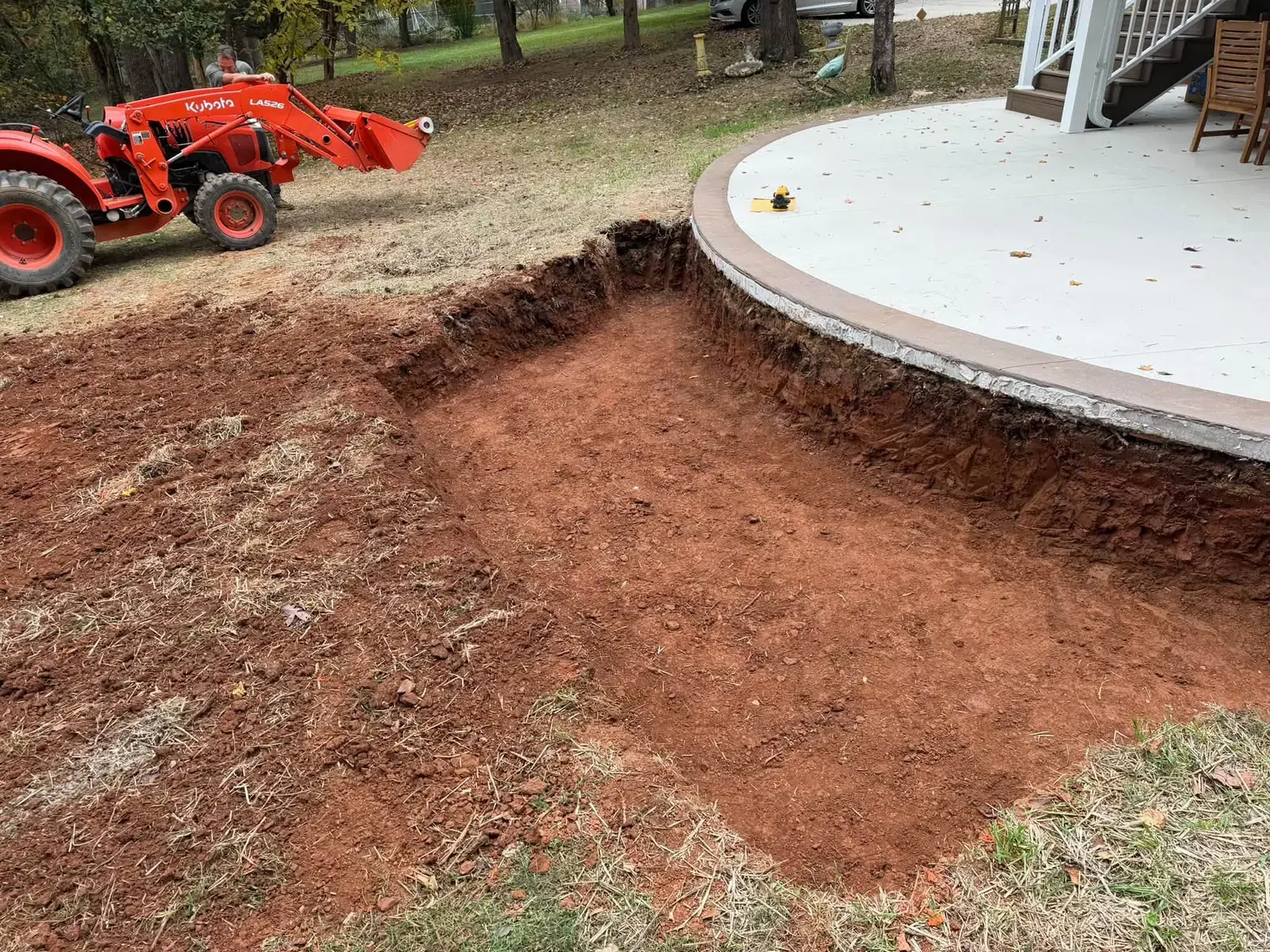
The same goes for the rest of the excavation we do. Before a footer trench, a wall's base or a patio's subgrade is dug, the call is made and the marks are on the ground.
Excavation for Walls, Footers and Banks
Much of our digging is the first step of other work. A footer trench is dug to the depth and width the job calls for, with a flat, firm bottom. A wall's base trench is dug wide enough for the gravel pad and the drainage stone behind it. A patio site is cut level, with the topsoil and roots taken out before any gravel goes in.
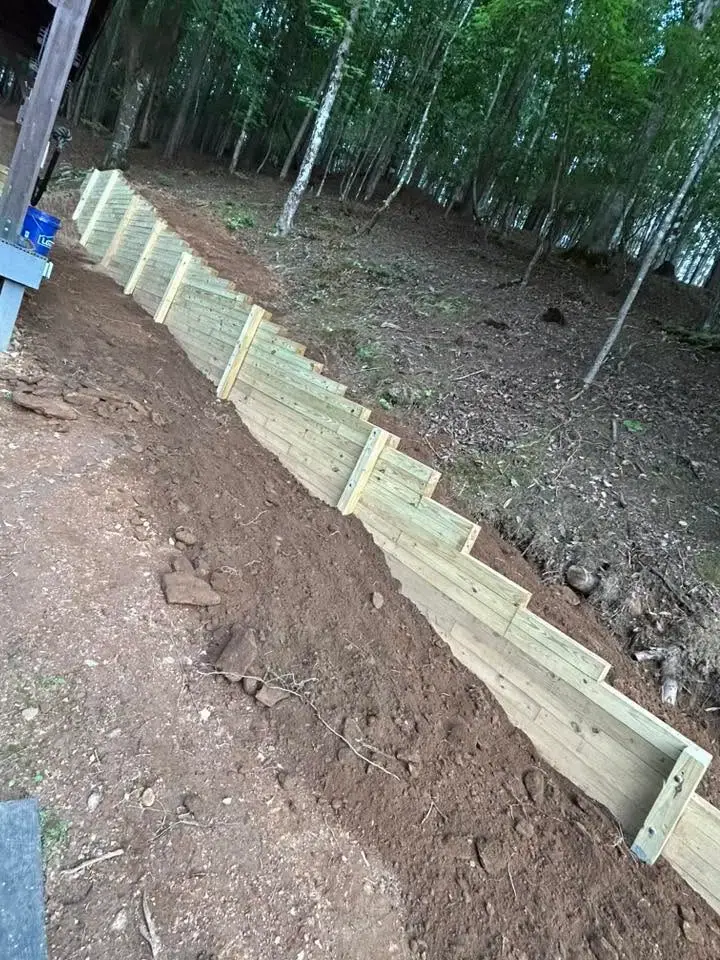
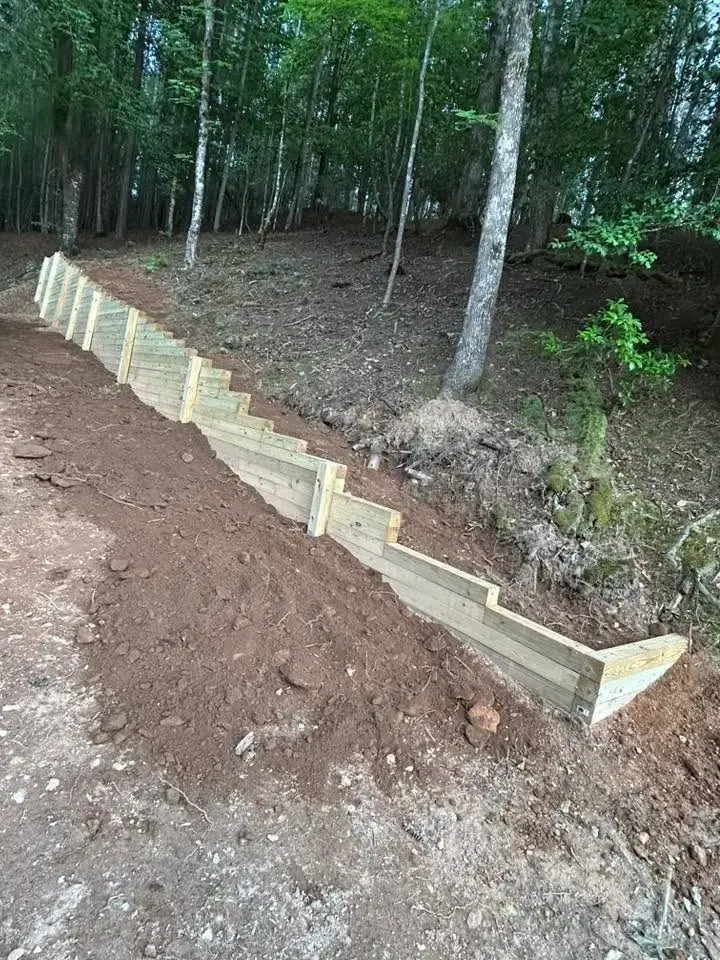
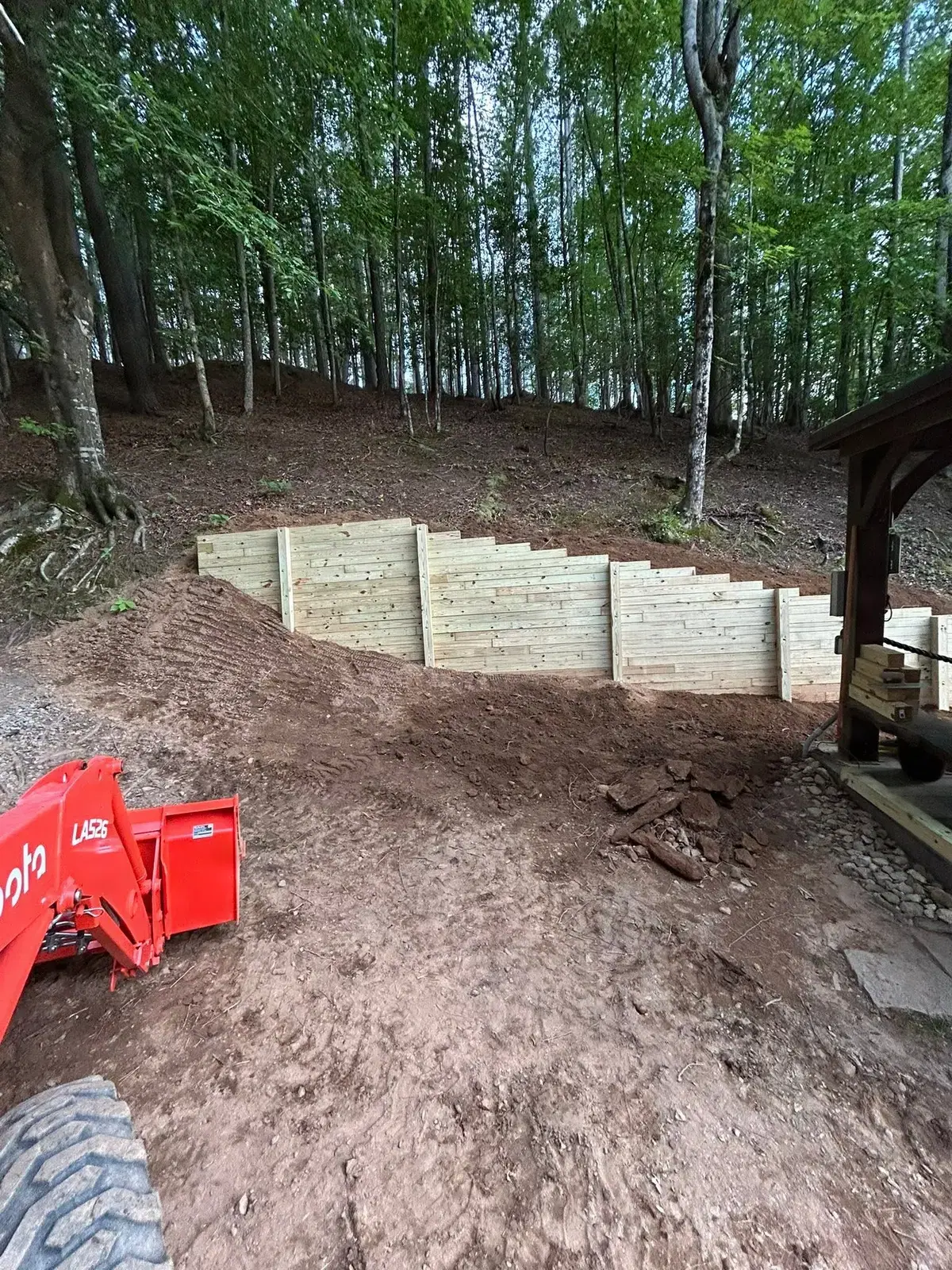
Sometimes the digging is the job. On a lot at Lake Rhodhiss, the homeowner wanted more room behind the gazebo, so we dug the bank back about 4 feet, with a strong wooden retaining wall to hold the new cut. We also put in a few French drains and did some grading around the dock to keep everything from washing out. On a lake lot the slope runs straight to the water, so drains and grading matter as much as the wall in keeping the bank where it is.
What Decides the Cost of a French Drain or Grading Job
A French drain or a grading job is priced on the site, and what decides it:
- Length of the drain. How many feet of trench, pipe, fabric and gravel.
- Depth. A deeper trench means more digging and more stone.
- Where the water goes. A short run to daylight is a smaller job than a long run or a dry well at the end.
- Rock. Rock in the trench line slows the digging down.
- Access for a machine. A machine where it can reach, hand digging where it can't, and the lawn to put back after.
- How much soil moves. On grading, the soil cut and filled, fill or topsoil brought in, and any hauled away.
We take on drainage and grading jobs around Morganton and out to Lenoir and Marion. Call or text (828) 390-8226, or send photos of where the water stands through the contact form, for a free estimate.
Water Standing Where It Shouldn't?
Call (828) 390-8226 for a free estimate.
Photos From Our Jobs
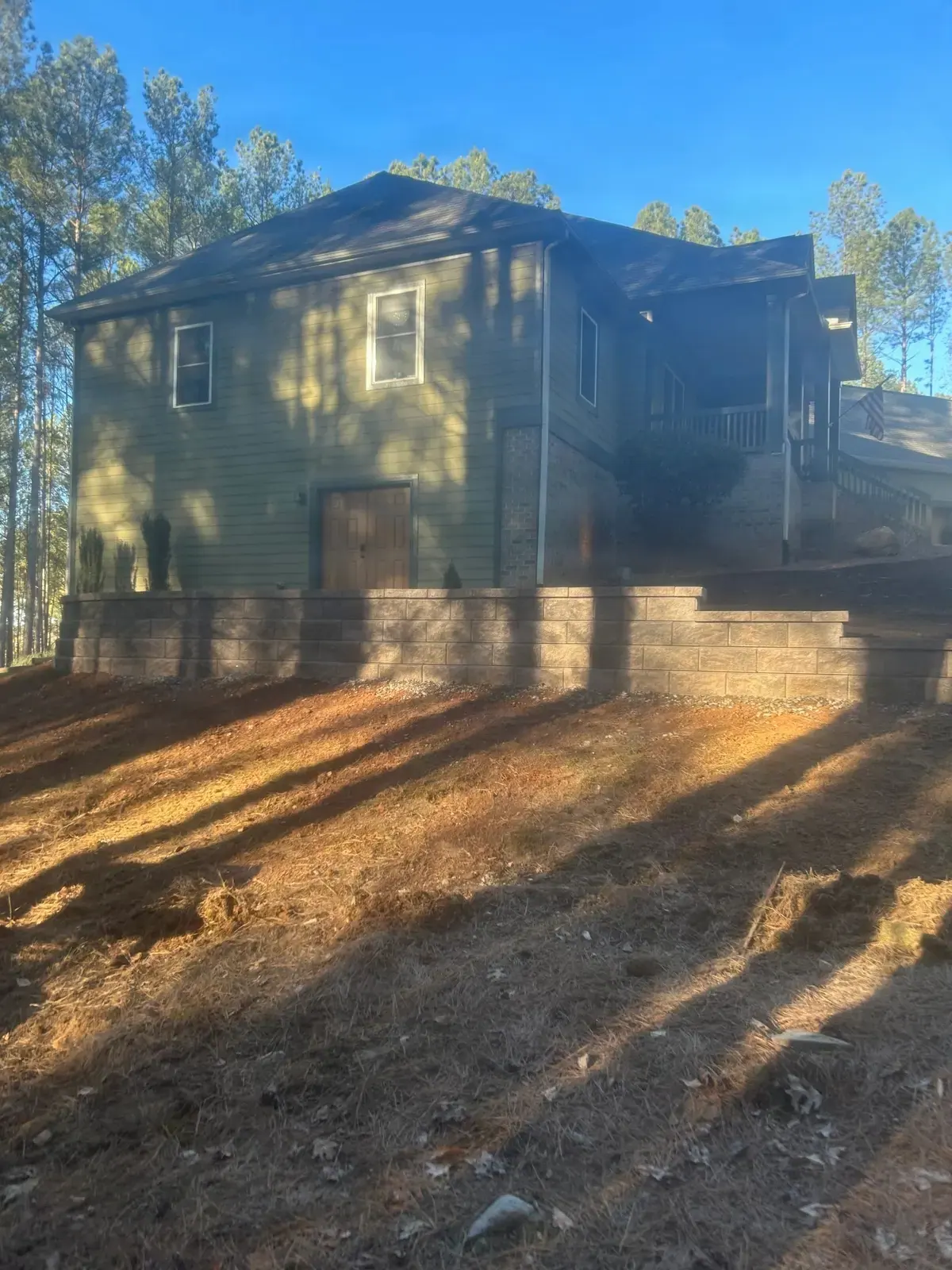
Every photo here is from one of our own jobs. Tap one to see it bigger.



Questions We Hear a Lot

-
It depends on the length of the drain, how deep the trench runs, where the water has to go, whether there is rock in the way, and whether a machine can reach it or it is dug by hand. A dry well at the end adds to it. Call or text (828) 390-8226 for a free estimate.
-
Grading is priced on how much soil has to move: what comes off the high spots, what fill or topsoil comes in, and what gets hauled away. The size of the area, how steep it is and access for a machine decide the rest. Send photos or call (828) 390-8226, and we'll give you a free estimate.
-
If water runs across the surface toward the house, grading the soil to fall away from it often fixes it. If water comes up out of the ground, seeps out of a slope or keeps a spot soggy after the surface is dry, it is moving through the soil, and a French drain catches it. Many yards need some of both.
-
Deep enough to catch the water where it moves: shallower for a soggy spot in the yard, deeper along a foundation or at the foot of a slope. The trench also has to fall the whole way to its outlet, so its depth changes along its length.
-
Yes. NC 811 says: “Contact 811 or 1-800-632-4949 three working days before you plan on digging.” The buried lines get marked before any trench or grading starts.
-
Yes. We offer free estimates. Call (828) 390-8226, send us a message on Facebook or use the contact form.
-
We serve Morganton, NC and the surrounding areas. Recent jobs include Lake James, Lake Rhodhiss, Valdese and Marion. Call (828) 390-8226 to check your location.
-
- Service Area Morganton, NC & surrounding areas:
Valdese, Marion, Lake James & Lake Rhodhiss - Free Estimates Call, text or message usMorganton, NC & nearby
- Find Us Online


